Wednesday, February 13, 2013

Vegetarian Mofongo


Two weeks ago I was in Puerto Rico for a few days. It was difficult for me because I am a vegetarian who doesn’t eat fish and generally, the food in PR is very heavy on the meat or fish. We had been warned not to eat fresh vegetables because they would have been washed in local water that the delicate bellies of Canadians might not be able to tolerate. While there, I heard of several incidents of people throwing caution to the wind and ending up in their bathrooms for hours on end. 

If the vegetables and fruit had a peel on them and the peel was removed, they were considered safe. So I existed on cucumbers (peeled), oatmeal, protein bars that I brought from home, melon, and bananas. By the end of the 5 days my stomach was a mess.

On the last night of the trip, we ate in a restaurant on the resort grounds and it was the first meal that everyone really enjoyed. I was a bit put off when I first looked at the menu because again, it was full of meat and fish. I spotted some rice and beans so I ordered that, but was informed that the beans actually had pork in them. I asked the very patient waiter if there was anything at all on the menu that I could possible eat. He responded with one word: mofongo. 

Mofongo is essentially fried plantain with garlic. http://en.wikipedia.org/wiki/Mofongo It has a texture not unlike potato, and the flavour is mellow and basically takes on the flavours of whatever it is cooked with. I had never had plantain before because I always assumed it would be sweet like bananas. I could not imagine something as sweet as a banana in a savoury dish, but plantain is not really sweet at all. Traditional mofongo contains pork (what a surprise), but the waiter assured me that the chef could make a true vegetarian mofongo for me. I decided that it would be good to try a traditional Puerto Rican dish at least once before leaving town, so I ordered it. It arrived in the form of a tower. The tower was hollow and inside was filled with overcooked and slightly bland vegetables. Aside from those vegetables, it was delicious.

Here is a photo of my Puerto Rican mofongo (apologies for the blurriness):


As soon as I returned to Toronto I did some research on mofongo recipes. One of my thoughts on the version I ate in PR was that it was a bit dry. The waiter explained to me that if I had ordered the meat or fish version, it would have come with a sauce. Because the veggie version was made specifically for me (and one other colleague who is also a vegetarian), there was no sauce. I decided that for my mofongo I would add caramelized onions since they make everything better. I also figured the oil from the cooking of the onions would add some moisture to the dish. 

I also topped my mofongo with sautéed veggies, but for my version, I added water to the pan near the end of cooking to make the veggies saucier (almost like a broth). This worked well but for the next time, I think I will make a separate veggie broth to just ladle over the entire plate before serving. My husband, who is not a vegetarian, ate his mofongo with au jus on top (he happened to be making a pot roast at the same time and so he took a ladle of the jus and used that to moisten the mofongo. He had two helpings.)

I got my eldest son to try to mofongo and he thought it was pretty good. This leads me to believe that I could form the mofongo mash into French-fry shapes, “batter” them with egg whites, and double bake them to make them like crispy French fries. This will be my next recipe test so stay tuned for that.

In the meantime, here is how I made my mofongo. The recipe I used as inspiration was from http://suite101.com/article/adventurous-cooking-vegetarian-mofongo-a105334 . My only comment on this web recipe would be that the instructions were not 100% clear. Hopefully my instructions below will be easier to follow.

Ingredients:
This recipe will make 4 – 5 mofongo patties. Enough for a side dish for 3 – 4 people, or a main dish for 2 people. 

2 green plantains, peeled and sliced (note that you have to use a paring knife to remove the peel – it doesn’t come off cleanly as with a banana because the fruit is unripe)
½ tsp salt
2 cups cold water
2 cloves garlic, peeled and left whole
1 medium sweet onion, diced
Olive oil (or vegetable oil) for frying the plantain
Salt and pepper
Yellow, red, orange peppers (your choice), sliced thinly
1 stalk celery, chopped
1 carrot, sliced thinly
1 clove garlic, crushed
Feel free to add additional veggies if you have them on hand (perhaps zucchini, mushrooms, broccoli, cauliflower, etc.)
Water
Vegetable bouillon cube (if you opt for the veggie broth on top)

Method:
Soak the plantains in 2 cups cold water and ½ tsp salt for 15 minutes. Drain in a colander and pat dry with paper towel.


Heat the olive oil in a sauté pan at medium high heat and add the diced onions and whole garlic. After about 5 minutes, add the sliced, soaked, drained plantain. Fry the plantain on each side until golden brown (about 10 minutes).


Remove from heat and let cool for a couple of minutes. Pour the contents of the pan onto a chopping board and roughly chop it all up. Thank you to my husband who did this for me.


Transfer to a bowl and use a potato masher to mash it all together.  Add water or broth to make the mixture easier to handle - it will be dry.


Note: if you have a mortar and pestle large enough for the mofongo, you can skip the chopping and mashing and go directly to the mortar and pestle.

You can eat the mofongo now, or you can fry or bake it again to crisp up the outside. Before you crisp it up, make your sauté of veggies.

Heat some more oil in a pan (or use cooking spray). Sauté the onions and garlic for about 2 minutes at medium high heat, then add the celery and carrots and sauté for another 2 minutes or so. Finally, add the peppers and other veggies. Near the end of the cooking add about a cup of water to deglaze the pan and make a bit of broth. Add some salt and pepper and other herbs if desired. I didn't add any wine but I suppose you could to add deeper flavour.


Use a vegetable bouillon cube and some boiling water to make an additional broth on the side. Do not add this broth to the veggies as it will make vegetable soup which is not really what you are going for.

To crisp up the mofongo, the recipe I consulted (website above) suggested making small balls of the mixture, flattening the ball into a patty, and either frying it in the same pan or putting it in the oven on a greased cookie sheet (250 degrees for 5 minutes). I opted for the cookie sheet/oven option but found there was no way this was going to crisp up in a 250 degree oven. I ended up raising the rack and broiling at 500 degrees for 1 minute per side. 

These are my mofongo patties before being baked.


Place the mofongo patties on a plate, top with the sautéed veggies and broth. Serve while hot. If you are serving as a side dish, you can top it with whatever sauce you are serving with your main.


Enjoy!


Tuesday, February 5, 2013

Homemade Pretty Healthy Granola Bars That Also Taste Good


As most parents know, schools these days are peanut-free. Not like when I was a kid and I took a peanut butter and jam sandwich to school pretty much every single day. For 15 years. Now each night I struggle to come up with something that is nutritious, not boring, and not processed. It’s not just the ‘main course’ that’s a problem, but the snacks too. I used to buy granola bars because they are labelled peanut-free, and then I decided to take a closer look at the ingredients list. Palm kernel oil, corn syrup, things I cannot pronounce, etcetera - a cause for concern.

I have tried to make homemade granola bars in the past and they didn’t turn out well at all. They fell apart and just didn’t taste that great. I never let a recipe-gone-bust deter me from trying again though, so last night I found myself toasting some oatmeal in the oven while my big guy finished his homework.

I found an interesting-sounding recipe on line on a blog called Butter Crumbs, but it was full of nuts and nut butters so I had to adapt (what else is new?).

Here is my adaptation, with notes and advice for future attempts.

Ingredients:

2 cups rolled oats
¼ cup oat bran
1/3 cup wheat germ
½ cup honey/maple syrup mix
¼ cup sunflower seeds
2/3 cup bran cereal
¼ cup olive oil
4 quick grinds of salt (about ¼ tsp)
2/3 cup chocolate chips

Method:

Place the oats, oat bran and wheat germ on a cookie sheet in a 350 degree oven. Toast the ingredients for 5 - 10 minutes, stirring halfway through. Let cool.


Meanwhile, while the oats are toasting, mix all the other ingredients in a large bowl.

Once the oats are cool, add them as well. Stir really well ensuring you coat all the dry with the wet ingredients.


Note: I didn’t let the oat mixture cool and when I added the warm oats to the rest of the ingredients, the chocolate chips melted. This is not necessarily a bad thing but if you want to see the chocolate chips intact in your granola bar, then let the oat mixture cool before adding it to the bowl of other ingredients.


Line a cookie sheet with parchment paper and pour the mixture onto the sheet. You then need to use something with a straight edge to shape the mound of oats into a rectangle shape. I used a large cleaver but you could also try a ruler. Your oats should be flattened to about ¼ - ½ inch thick. You can use a spatula to do this. If it is sticky, try spraying the spatula with a touch of cooking spray first (or brush with olive oil).


Once the shape is right, place the tray in the oven for 12 minutes at 350 degrees F. I baked mine for 14 minutes and they were a bit overdone. 10 minutes will give you a chewy bar, 12 minutes will give you something more crunchy.

Lift the parchment paper off of the hot cookie try to help the granola cool. While the oats are still warm, cut the rectangle into 16 bars.


If you follow this recipe exactly, each bar is 5 Weight Watchers points (for the Points Plus system). If you want to make these and cut back on the points, you can cut the chocolate chips in half, cut out the sunflower seeds, or replace the chocolate chips with raisins or dried cranberries.

If you don’t have to worry about being nut-free, you can replace the oil with peanut butter or almond butter. You can also add any kind of nut that you want to. 

Enjoy! And tell me about your variations – I’d love to hear all about them.


Monday, February 4, 2013

Black Bean & Chick Pea Soup with Sour Cream & Lime Topping


There’s no place like home. 

This past week I spent five long days in Puerto Rico. You may think that this is awesome, but I was there for work and was without my two kids and husband for that time. In addition, the travel time to get to Puerto Rico was about 12 hours (12 hours to get home as well), and the weather wasn’t even stellar (although it was definitely better than the weather in Toronto).

I missed my kids, my husband, my dog, even the hamsters. What I also missed was the ability to cook my own food. It’s one thing to go out for a dinner here, a breakfast there...but 5 days of that is tough. Especially when one is a vegetarian and Puerto Ricans love meat!

I arrived home late on Saturday night and the first thing I did on Sunday was to figure out what food I would prepare that day. I looked in the pantry to see what was there and spied some black beans. You’d think there would be lots of beans on hand in Puerto Rico, and there were, but they all had pork mixed in with them.

I decided to make a black bean soup so I turned to one of my newer cookbooks to check out the recipes. I found one that looked good in Vegetable Soups from Deborah Madison’s Kitchen. The King of Soup was heading out to watch the Super Bowl with his buddies, but before he left he was kind enough to prep all the veggies for me (what a Prince, I mean King).

I started cooking and went to the pantry to get the beans. Uh oh, only one can and the recipe called for 3. How about some chick peas instead? Sure! Why not?

Here is my soup, adapted from Deborah Madison’s recipe.

Ingredients:

1 14 oz can black beans, drained and rinsed (original recipe calls for 3 cans of beans and no chick peas)
1 14 oz can chickpeas, drained and rinsed
3 tbsp olive oil
1 large, sweet onion, finely diced
2 small carrots, finely diced
3 celery ribs, finely diced
1 green bell pepper, finely diced
3 garlic cloves, minced
1 bunch of cilantro, stems finely sliced and leaves more roughly chopped
1 tbsp ground cumin
1 tsp smoked Spanish paprika, or more to taste
2 bay leaves
¼ tsp cayenne, or more to taste (I think it needs more)

Topping:

½ cup sour cream
Juice of ½ lime, or more to taste (I used one full lime and I think I might even add more lime to the actual soup)
Pinch of salt (I added freshly ground pepper as well)

Directions:

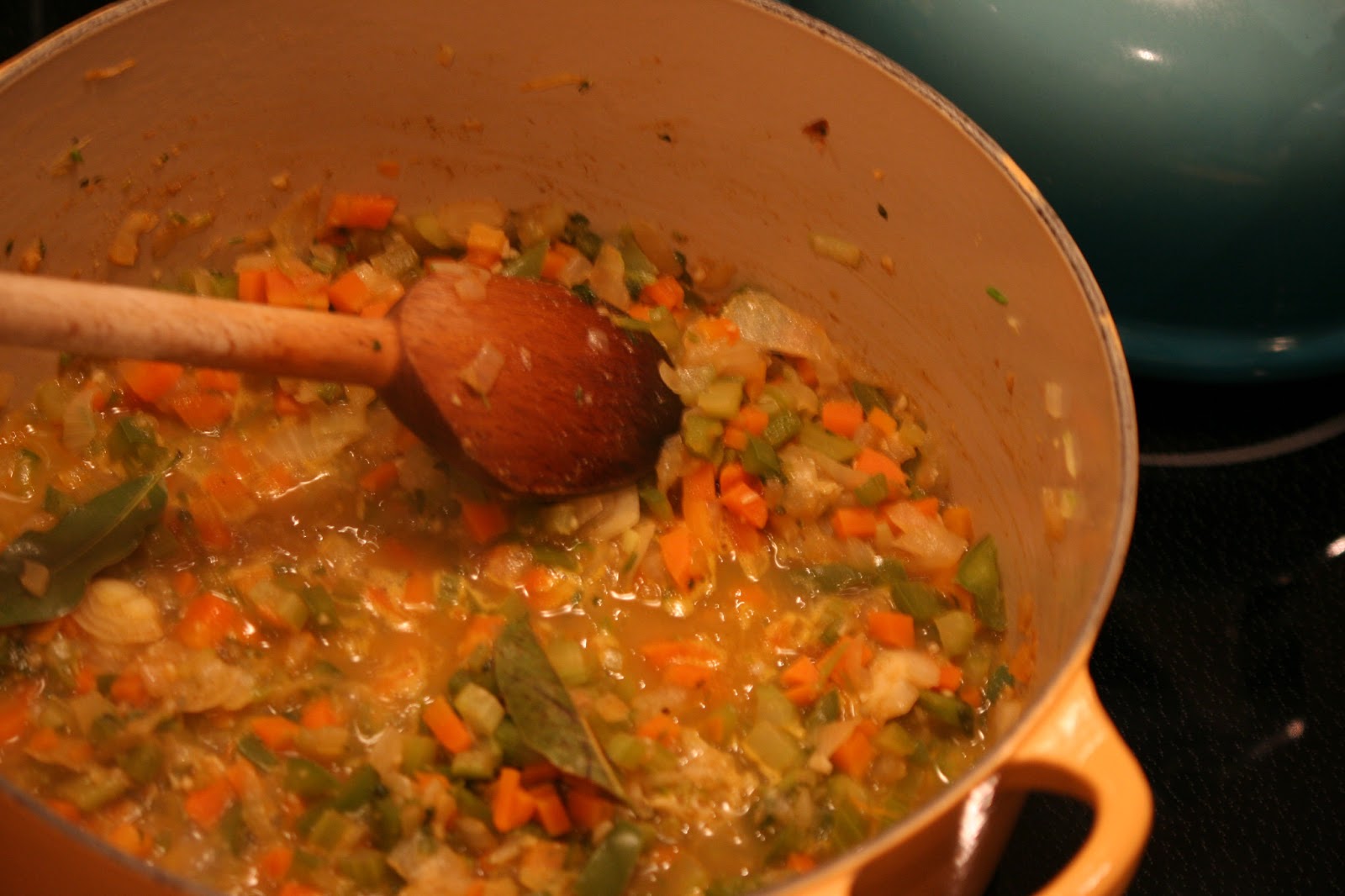
Heat the oil in a medium-sized pot (I used my cast iron Le Creuset). Sauté the diced veggies and cilantro stems over medium-high heat until the onion has softened (stir often). Add 1 tsp salt and then add the cumin, paprika, bay leaves, and cayenne. Lower the heat and cook for about 10 minutes more. Stir every couple of minutes and try not to let the spices burn.

Add 1 cup of water and cook for another 8 minutes or so.


Add the beans and the chick peas, another cup or more of water (original recipe does not call for additional water, but I felt it needed it to truly simmer), and 3 tbsp of the chopped cilantro leaves. Cook for about 20 minutes. Taste, and add salt and pepper as required.


Mix the sour cream, lime juice, the rest of the cilantro leaves and a pinch of salt in a separate bowl.

Puree the soup using a hand blender (original recipe does not call for pureeing). Serve hot with a dollop of the sour cream mixture on top. (I think toasted pumpkin seeds or sunflower seeds would also be great with this soup.)


P.S. I did have the chance to eat an excellent Puerto Rican staple called Mofungo (fried plantain and garlic mash). I plan to do some research and test out my own recipe so stay tuned to this space...